


National Mailbox Improvement Week for Communities
National Mailbox Improvement Week for Communities
Friday May 15, 2026Every May, National Mailbox Improvement Week encourages homeowners and communities to inspect their mailboxes and correct problems that may interfere with safe, efficient mail delivery.
For homeowners associations, property managers, developers and community leaders, the week is also an opportunity to look beyond basic mail delivery. Mailboxes are among the most visible and frequently repeated features in a residential community. Their condition can affect curb appeal, neighborhood consistency and the impression residents and visitors form as they travel through the community.
A mailbox does not need to be elaborate to contribute positively to its surroundings. It does, however, need to be secure, properly positioned, clearly numbered and maintained well enough to continue serving its purpose.
Why Mailboxes Matter to Community Appearance
Mailboxes are practical objects, but they also become part of the streetscape.
A row of coordinated, well-maintained curbside mailboxes can help:
Create a clean and consistent neighborhood appearance
Make addresses easier to identify
Improve first impressions for visitors and prospective buyers
Reinforce HOA or community design standards
Demonstrate regular property upkeep
Support a stronger sense of neighborhood identity
Problems become especially noticeable when the same mailbox design appears throughout a community.
A single leaning post, damaged door or missing address number may seem minor. When several mailboxes have faded finishes, mismatched components or makeshift repairs, the entire streetscape can begin to look neglected.
National Mailbox Improvement Week provides a natural time for communities to identify those problems and address them systematically.
Begin With a Community Mailbox Inspection
Before organizing repairs or replacements, conduct a visual inspection.
HOA board members, property managers or community volunteers can document common issues such as:
Leaning or unstable posts
Loose mounting hardware
Damaged mailbox doors
Missing handles or flags
Rust or corrosion
Faded or peeling finishes
Missing or unreadable address numbers
Obstructed access
Overgrown landscaping
Irrigation damage
Inconsistent replacement boxes
Mailboxes positioned too close to other obstacles
Photographs and a simple address-by-address checklist can help the community distinguish isolated maintenance problems from larger systemwide issues.
The inspection should also note whether existing mailboxes still match the community’s approved design standard.
Organize a Mailbox Refresh Day
Mailbox maintenance can become a shared community initiative rather than a series of disconnected individual projects.
An HOA or property manager might designate a weekend as a community Mailbox Refresh Day.
Residents can be encouraged to:
Wash dirt, pollen and mildew from mailbox surfaces
Replace damaged or faded address numbers
Tighten loose hardware
Straighten minor alignment problems
Remove weeds and overgrown vegetation
Refresh mulch or edging
Report damaged doors, posts or mounting components
Confirm that the mailbox remains accessible to the mail carrier
Provide residents with clear instructions before the event. A simple checklist can improve participation while helping everyone work toward the same visual standard.
Communities should avoid encouraging residents to repaint, alter or replace components without first confirming approved colors, materials and product requirements.
Reinforce HOA Mailbox Standards
National Mailbox Improvement Week is a useful time to recirculate mailbox guidelines.
Standards may address:
Approved mailbox models
Post styles
Colors and finishes
Address-number placement
Newspaper receptacles
Mounting height
Placement
Landscaping restrictions
Replacement procedures
Responsibility for repairs
The goal should not be to turn mailbox maintenance into a punitive exercise. Clear standards help residents understand what is expected and prevent improvised repairs that create inconsistencies later.
When possible, provide photographs or product references showing the approved design.
Communities that use standardized mailbox products may also benefit from maintaining a list of approved Forsite products and available replacement components.
Improve the Area Around the Mailbox
The condition of the landscaping around a mailbox can matter almost as much as the mailbox itself.
Potential improvements include:
Removing weeds
Trimming shrubs
Refreshing mulch
Repairing edging
Adding low-maintenance ground cover
Redirecting irrigation
Removing plants that obstruct carrier access
Improving drainage around the post
Plantings should not interfere with mail delivery, vehicle visibility or maintenance access.
In Tampa Bay and other warm, humid regions, irrigation overspray, intense sunlight and rapid plant growth can accelerate wear. Communities should choose landscaping and mailbox materials that can tolerate local conditions without requiring constant correction.
Use Participation to Build Community Pride
A mailbox-improvement campaign can also give residents a visible, achievable way to contribute to the neighborhood.
Possible participation ideas include:
Best Mailbox Makeover
Most Improved Mailbox
Best Mailbox Landscaping
Best Maintained Street
Community Volunteer Recognition
Recognition does not need to be elaborate. A newsletter mention, community website feature or small certificate may be enough to encourage participation.
The larger purpose is not competition. It is to make routine maintenance feel like a shared investment in the community.
Know When Maintenance Is Enough
Many mailbox problems can be corrected with cleaning, new address numbers, tightened hardware or replacement components.
Maintenance may be sufficient when:
The mailbox body remains structurally sound
The post is stable
Replacement parts remain available
The finish can be restored
The design still matches community standards
Most units remain in serviceable condition
Communities should document the approved repair method so that one household does not use a different paint, number style or hardware solution from everyone else.
Know When Replacement Makes More Sense
Repairs become less economical when mailbox systems are aging unevenly or replacement components are increasingly difficult to obtain.
Replacement may be the better option when:
Posts are repeatedly leaning or failing
Corrosion affects structural components
Doors no longer close securely
Multiple mailboxes need major repairs
Existing designs are no longer available
Residents have installed mismatched replacements
Maintenance expenses continue increasing
The community is completing a broader streetscape renovation
Replacing mailboxes as a coordinated project allows the HOA or property manager to select a durable standard and avoid a patchwork of unrelated products.
Upgrade Curbside Mailboxes as a Community
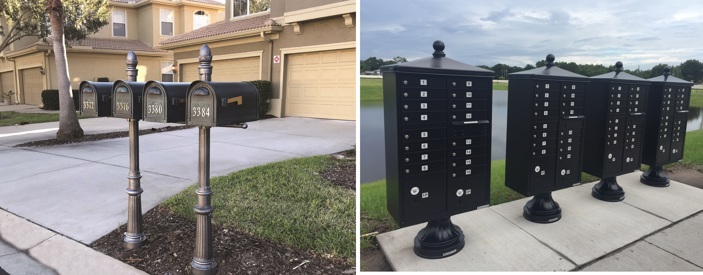
Uniform curbside mailboxes can improve both appearance and long-term maintenance planning.
A coordinated replacement program may provide:
Consistent mailbox and post designs
Standardized address numbering
Easier access to replacement components
Predictable finishes and materials
A cleaner streetscape
Better alignment with community architecture
Fewer improvised homeowner replacements
Before selecting a system, determine:
How many mailboxes are involved
Whether newspaper receptacles are required
Who owns and maintains each mailbox
Whether the community will purchase units collectively
Who will handle installation
Whether existing foundations or mounting locations can be reused
Which colors and architectural details complement the neighborhood
Forsite can help HOAs, property managers, builders and developers compare mailbox styles and coordinate a communitywide product standard.
Consider Centralized Mailbox Systems
Some developments may be better served by centralized mailbox systems.
Cluster Box Units, commonly called CBUs, provide secure individual mail compartments within one centralized installation.
Potential advantages include:
Centralized mail delivery
Secure, lockable resident compartments
Integrated parcel lockers
A more organized installation
Reduced duplication of individual posts
Easier coordination in new developments
Opportunities to combine mailboxes with shelters, lighting or site furnishings
Centralized systems require careful planning.
The project team should consider:
USPS coordination
Resident accessibility
Parking and pedestrian access
Lighting
Weather exposure
Drainage
Concrete pads
Parcel volume
Accessibility requirements
Future expansion
Site security
Maintenance responsibility
A centralized mailbox location should be treated as a small community amenity rather than a box placed wherever space happens to remain.
Plan Mailboxes Early in New Developments
For builders and developers, mailbox planning should begin early in the site-development process.
Early planning helps coordinate:
Mail delivery type
USPS review
Locations
Roadway and sidewalk design
Accessible routes
Lighting
Landscaping
Drainage
Resident parking
Architectural finishes
Future maintenance
Waiting until late in development may limit available locations or force mailbox systems into spaces that were not designed for resident access.
Mailbox systems should complement the wider streetscape, including signage, lighting, sidewalks, landscaping and community gathering areas.
Create a Long-Term Mailbox Maintenance Plan
National Mailbox Improvement Week should be the beginning of a maintenance cycle, not the only time anyone looks at the mailboxes.
A simple annual plan may include:
Spring inspection
Cleaning
Address-number review
Hardware checks
Post-alignment checks
Landscaping clearance
Irrigation review
Corrosion inspection
Replacement-part inventory
Resident reminders
Documentation of approved products
The community should retain:
Product names
Model numbers
Paint or finish information
Installation instructions
Warranty records
Replacement-part sources
Vendor contacts
Photographs of approved configurations
These records make future maintenance easier for board members and property managers who were not involved in the original installation.
Small Improvements Can Change the Whole Streetscape
National Mailbox Improvement Week is a reminder that community improvement does not always begin with a major construction project.
Cleaning a mailbox, replacing worn numbers, correcting a leaning post or refreshing nearby landscaping may seem minor. Repeated across dozens or hundreds of homes, those improvements can noticeably change the appearance of a neighborhood.
They can also:
Encourage residents to participate in community upkeep
Reinforce pride of ownership
Improve consistency
Make addresses easier to identify
Reduce deferred maintenance
Prepare the community for future replacement planning
The mailbox is a small feature with an unusually large visual footprint.
Ready to Improve Your Community Mailboxes?
Whether your neighborhood needs replacement components, coordinated curbside mailbox upgrades or a complete centralized mailbox system, Forsite can help evaluate the available options.
Forsite works with HOAs, property managers, builders and developers to create mailbox solutions that support community appearance, practical maintenance and long-term use.
Contact Forsite to discuss your community mailbox project.
